Wind energy is rapidly expanding into regions where tropical cyclones are not a rare anomaly but a defining feature of the climate: the Taiwan Strait, the South China Sea, Vietnam, the Philippines, Japan, and Korea. These regions represent some of the fastest-growing offshore wind markets in the world, yet they also experience some of the most extreme wind and wave conditions on Earth.
Together with fifteen co-authors from national laboratories, universities, and industry, we have recently published a review in Wind Energy Science examining the current state of knowledge on designing wind energy systems for tropical cyclone environments. It spans atmospheric science, structural engineering, offshore hydrodynamics, reliability, and risk, but one theme runs through all of it: our ability to build wind farms in these regions is advancing more quickly than our ability to quantify the loads they will experience.
The under-design / over-design trap
Modern wind turbine design standards were developed primarily around the environmental conditions of the North Sea and northern Europe. Those standards have served the industry remarkably well, but they were never intended for the atmospheric conditions associated with tropical cyclones, and applying them directly to typhoon-prone regions creates two opposing risks.
Under-design
The first is under-design.
The characteristic 50-year design wind speed may be underestimated. The default turbulence models, such as Mann and Kaimal, assume neutral atmospheric boundary layers with stochastic turbulence that averages naturally over ten-minute periods. Likewise, design wave conditions are generally derived from extra-tropical storm climatology.
Tropical cyclones behave very differently.
Their turbulence contains coherent structures that can exceed the rotor diameter. Wind direction may change by 90° or more over relatively short periods. Strong air–sea heat exchange fundamentally alters the structure of the marine boundary layer, producing turbulence characteristics that conventional spectra do not represent.
The recently introduced IEC T-Class is an important step forward, increasing the reference wind speed to 57 m/s for tropical cyclone applications. However, it largely specifies the magnitude of the wind rather than its character. Two storms with identical peak wind speeds may generate substantially different structural loads depending on turbulence, directional variability, and the evolution of the atmospheric boundary layer.
As a result, a turbine designed strictly to current T-Class requirements may still encounter loading conditions that lie outside those considered during certification.
Over-design
The opposite outcome can be just as problematic.
Faced with uncertainty, developers and designers often respond by adding conservative assumptions throughout the design process. Conservative turbulence. Conservative waves. Conservative safety factors. Conservative operational assumptions.
The cumulative result can be a turbine that is heavier, more expensive, and more difficult to install than necessary.
In emerging offshore wind markets such as Vietnam and the Philippines, these additional costs directly affect project viability. Excess conservatism that cannot be justified quantitatively provides neither greater confidence nor better economics.
The objective is therefore not to choose between conservative and optimistic assumptions.
It is to represent the physics of the site accurately enough that the appropriate design margin can be established. Neither dangerously small nor unnecessarily large.
That remains one of the central research challenges identified in our review.
What a tropical cyclone actually does
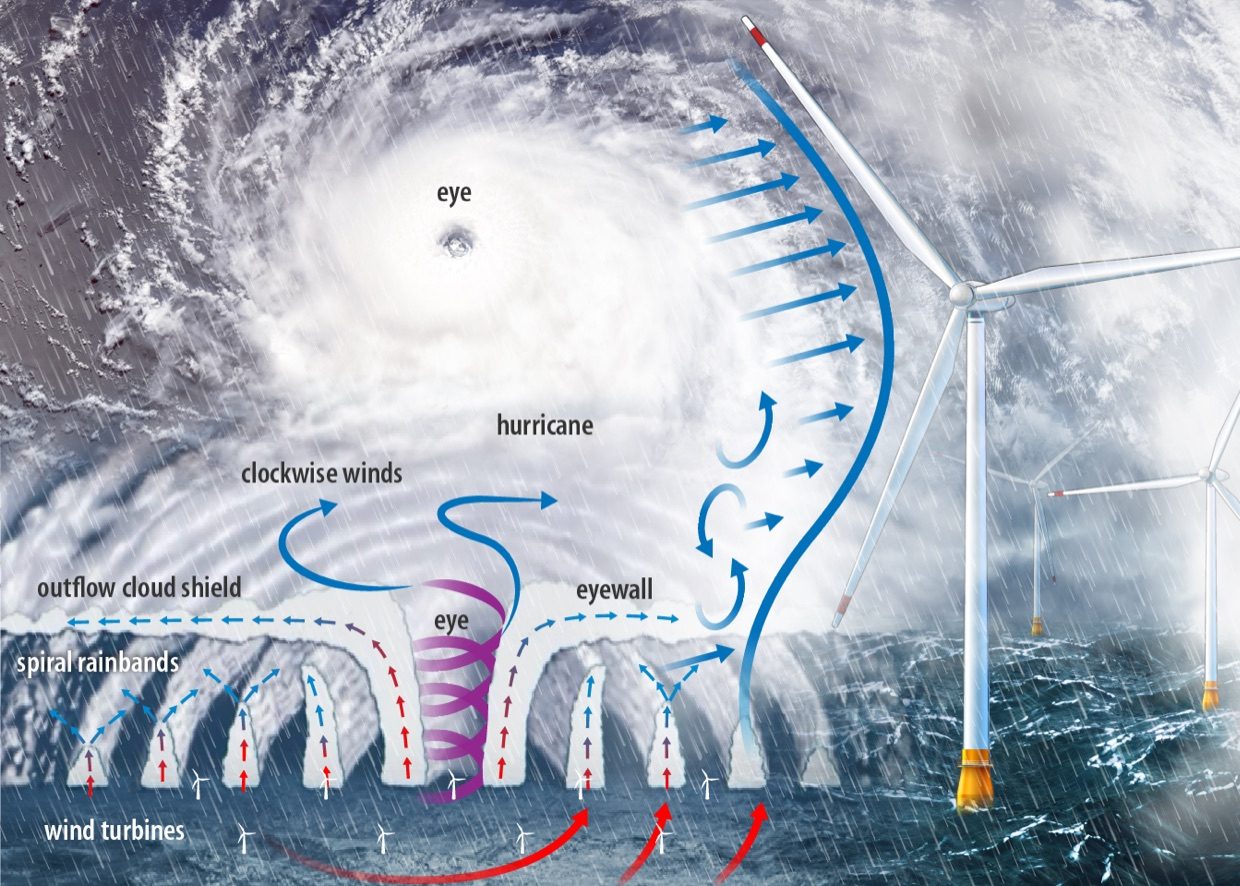
A tropical cyclone is a fully coupled atmosphere–ocean system: an eyewall containing the strongest winds, spiral rainbands with organized convection, a highly turbulent marine boundary layer, large surface waves, and storm surge, all evolving simultaneously as the cyclone translates across the ocean. Many of these interacting processes are simplified or absent within design conditions developed for extra-tropical storms.
The modeling gap
From the perspective of wind turbine design, tropical cyclone turbulence differs from extra-tropical turbulence in several important ways.
Higher turbulence intensity
The eyewall is among the most turbulent environments in the atmosphere. Turbulence intensities can substantially exceed those assumed in conventional design conditions, resulting in higher dynamic loading.
Larger coherent structures
Convective cells and mesoscale vortices embedded within rainbands can exceed the rotor diameter. Under these conditions, the assumption of homogeneous isotropic turbulence, which underpins many engineering turbulence models, begins to break down.
Rapid wind direction changes
As a cyclone passes, wind direction can rotate by 90° or more within a relatively short period. If a turbine loses grid power and becomes yaw locked while idling, sustained crosswind loading may dominate the structural response — a loading condition that current design methodologies rarely represent explicitly.
Wind–wave coupling
Wind generates the waves, but the waves also modify the wind. Sea-state-dependent surface roughness, wave breaking, and sea spray alter momentum exchange between the ocean and atmosphere, changing the structure of the marine boundary layer, so treating wind and waves as independent environmental inputs neglects this two-way interaction.
Idling does not mean unloaded
A parked turbine remains a loaded structure. Even when shut down and aligned into the wind, substantial aerodynamic and structural loads continue to act throughout the storm.
What realistic simulation looks like
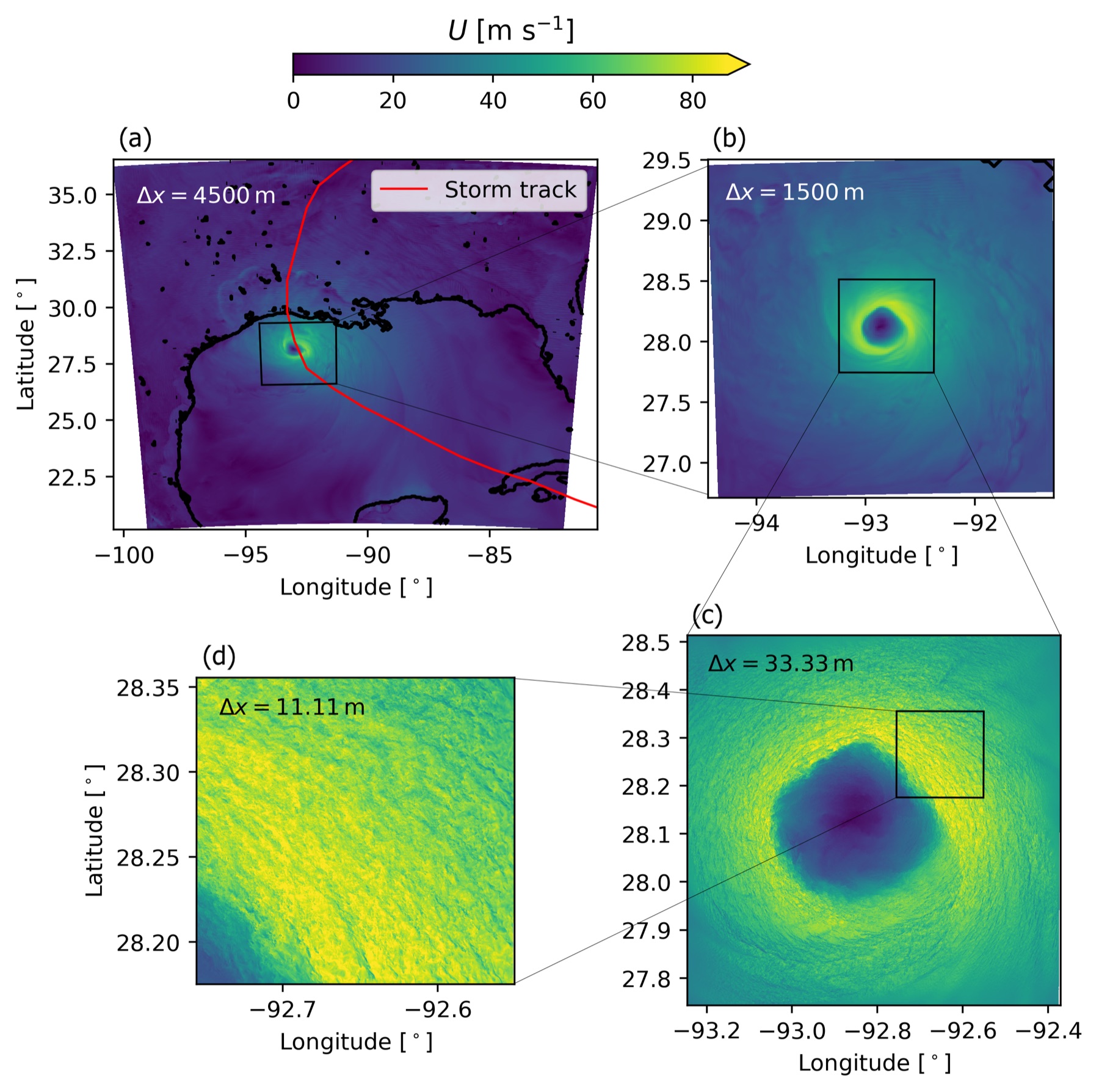
The research community can now model tropical cyclones with enough fidelity to capture much of what drives turbine loading. Figure 2 shows a coupled mesoscale-to-microscale simulation of Hurricane Laura (2020): a 4.5 km Weather Research and Forecasting (WRF) domain and a moving 1.5 km vortex-following nest supply the boundary conditions for turbulence-resolving large-eddy simulations at 33 m and 11 m, which resolve the flow around an individual turbine. The remaining challenge — a central message of our review — is translating simulations like this into engineering design loads that can be applied consistently within certification frameworks.
The standards gap
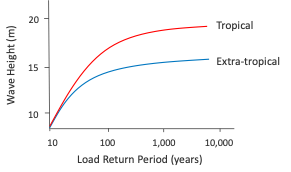
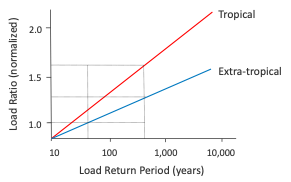
Capturing tropical cyclone physics is only part of the challenge; those advances must ultimately be reflected in engineering design standards. Current IEC design wind speeds, design wave heights, and partial safety factors were largely calibrated using extra-tropical environmental conditions, and applying those calibrations directly to tropical cyclone climates introduces two related problems.
The first concerns the environmental hazard itself. At long return periods, the extreme wind and wave statistics observed in tropical cyclone basins diverge significantly from those typical of extra-tropical regions, so a structure designed using extra-tropical design curves may experience environmental conditions beyond those anticipated during design.
The second concerns structural reliability. IEC partial safety factors are intended to convert characteristic loads into design loads that achieve a target probability of failure, and those calibration exercises assumed extra-tropical hazard distributions. If the underlying hazard changes, the same factors no longer guarantee the same level of reliability, so maintaining it requires recalibrating them for tropical cyclone environments rather than applying existing values unchanged.
Physics alongside statistics
A similar gap exists in risk assessment. Most catastrophe models estimate losses by combining historical storm catalogues with empirical vulnerability functions, an approach that has been remarkably successful for mature insurance markets where observational records are long and asset behaviour is well understood. Offshore wind in tropical cyclone regions is different: the observational record is short, the turbines being deployed today are substantially larger than those in historical loss datasets, and new foundation concepts such as floating platforms have little or no operational history under severe tropical cyclone loading. Historical observations remain indispensable, but they cannot fully describe the risk of assets that have never experienced the events they are being designed to withstand.
This is where physics-based modelling complements statistical methods rather than replacing them. Instead of asking “What happened historically?”, it asks “What would happen if this turbine experienced this storm?” The objective is no longer to reproduce the past, but to quantify the response of a specific turbine, at a specific site, under a physically consistent range of tropical cyclone scenarios — including events that may not yet have occurred in the record. Framed this way, tropical cyclone risk is fundamentally a probabilistic engineering problem built on four connected components:
- Hazard. What range of wind, wave, and current conditions can occur at the site, and with what probability?
- Structural response. How does the turbine respond to those environmental loads?
- Fragility. Given that response, what is the probability of damage or failure?
- Consequence. If damage occurs, what are the operational and financial impacts?
Each component needs a different type of model: synthetic tropical cyclone catalogues spanning 10,000 to 100,000 simulated years for the hazard, aeroelastic simulations of the actual turbine under site-specific conditions for the response, fragility functions that translate that response into probabilities of component failure, and consequence models for repair costs, downtime, and business interruption. Removing any one leaves an incomplete picture: hazard without response does not quantify loading, response without fragility does not estimate damage, and fragility without consequence says little about economic risk. Only when all four are combined can developers, lenders, insurers, and regulators evaluate resilience on a consistent engineering basis.
Eight gaps we identified
The review sets out eight specific research priorities:
1. Observational capacity. Long-range scanning lidars and Doppler radars at turbine-relevant heights (20–350 m), particularly offshore, where measurements remain sparse and rarely over open water.
2. Synthetic and probabilistic storm models. Validated against offshore TCs and spanning 10–100k synthetic years, with future-climate scenarios included.
3. High-fidelity simulations and reduced-order models. GPU-based LES that can feed engineering surrogates, along a tiered chain from high-fidelity to ROM to standards.
4. Turbulence and load frameworks. Beyond Mann/Kaimal and 10-minute averages, capturing shear, veer, and coherence across the rotor layer and around the storm.
5. Loads, standards, mitigation. Probabilistic safety factors tuned for tropical basins, wave–current misalignment treated explicitly, mitigation such as tuned mass dampers and advanced control evaluated systematically, and TC fatigue treated as its own limit state rather than spread over lifetime.
6. Breaking waves and ocean currents. An under-characterized loading mechanism for monopiles in shallow-to-intermediate depths, where design still relies on simplified representations.
7. A definition of TC survivability. No consensus yet exists across academia, developers, regulators, and insurers on what “surviving” means — structural survival, operational readiness within some number of days, or an allowable damage state by component — and it must be defined before risk transfer can be.
8. Integrated risk assessment frameworks. Hazard, fragility, and consequence tied together, with TC-specific reliability targets and downtime losses inside the probabilistic frame — a transparent basis on which developers, owners, lenders, insurers, and brokers can balance upfront investment against long-term resilience.
Why this matters now
The growth is happening squarely inside the typhoon belt — Japan and Taiwan already building at scale, and Vietnam, Korea, and the Philippines moving from ambition toward real projects. These are the basins where the questions in this review stop being academic: which turbine, on which site, at which return period, and with how much margin?
The under-/over-design trap is the practical answer. There is no universal safety factor waiting to be found; the margin has to be built up from the physics of the site. For a developer, that is really a question of how well the risk on a particular seabed is understood before the money is committed.
Citation
Deskos, G., Wang, J., Arwade, S., Fisher, M., Hirth, B., Larsén, X. G., Lundquist, J. K., Myers, A., Pang, W., Pringle, W. J., Rogers, R., Sanchez-Gomez, M., Sun, C., Yamaguchi, A., and Veers, P. (2026). Grand challenges in designing resilient wind energy systems in areas prone to tropical cyclones. Wind Energy Science, 11, 2749–2782. 10.5194/wes-11-2749-2026